Consumer protection guide
How to spot a rogue plumber in London.
The complete UK homeowner's guide to spotting cowboy plumbers, dodgy tradesmen, overcharging operators and outright scammers, before you let anyone touch your property. Twenty red flags. Six free verification checks. Twelve common London scams broken down. Independent, vendor-neutral, free.
Every year, UK homeowners and London landlords lose tens of millions of pounds to rogue plumbers, dodgy heating engineers and outright scammers. This is the most full vendor-neutral consumer protection guide for the London plumbing industry that we know of. If by the end of it you choose a different company than us, that's fine. We'd rather have an industry full of educated customers and a few losses than an industry full of cowboys.
This page covers: 20 rogue-trader red flags, five things you should never pay for, six free verification checks you can do in 60 seconds, twelve common London plumbing scams, background checks every legitimate company should pass, what to do if you've been scammed, and frequently asked questions with proper answers.
The 20 rogue-trader red flags every London customer must know
If you spot any one of these, pause and verify before letting work proceed. If you spot three or more, walk away.
1. No Gas Safe Register card (or the engineer refuses to show it)
Anyone touching gas appliances, gas pipework or gas flues in Great Britain must be Gas Safe Registered, it's a legal requirement under the Gas Safety (Installation and Use) Regulations 1998. Every registered engineer carries a photo ID card with their unique registration number. If they can't or won't show it, don't let them work on gas. Verify live at gassaferegister.co.uk. Working unregistered is a criminal offence, and uninsured.
2. Cash-only payment terms or "discount for cash"
A legitimate VAT-registered tradesman invoices through their books and accepts card payment. "Cash only" usually means: no VAT, no paper trail, no insurance backstop, no warranty enforcement, no traceability. The 20% you think you "save" disappears the moment anything goes wrong, and you've forfeited every consumer protection in UK law including the Consumer Rights Act 2015 and Section 75 of the Consumer Credit Act 1974.
3. No written quote before work begins
Verbal quotes are not enforceable. Without a written quote that breaks down labour, materials and timeline you have zero protection against the price changing on the day. A legitimate plumber will provide a written quote (text, email or a phone screenshot is fine) before starting any chargeable work, even on emergency callouts.
4. High-pressure "you have to do it today" sales tactics
If a tradesman attending a small job tells you that you need £3,000+ of urgent additional work that "has to happen today before it gets worse", pause. Legitimate trades are always happy to give you 24 hours to get a second opinion. High-pressure same-day sales tactics are the single biggest indicator of overcharging or scaremongering for unnecessary work. The only exception: live gas leaks, live electrical faults and active flooding, and even those don't justify £3,000 commitments without proper documentation.
5. No proof of public liability or employer's liability insurance
A legitimate UK trades business carries Public Liability insurance of £1M,£10M minimum and Employer's Liability of £10M for any company employing engineers. Ask to see the certificate, most will email it to you within minutes. If they can't or won't provide it, walk away. An uninsured tradesman who damages your property leaves the cost on you.
6. Vague company information, no address, no Companies House number
Legitimate UK companies are registered with Companies House (publicly searchable at find-and-update.company-information.service.gov.uk) with a real registered office address, named directors, and filing history. Sole traders should have a UTR and a verifiable trading address. No registered address + no Companies House number + cash-only = walk away.
7. Price changes mid-job, "it's worse than I thought"
Sometimes legitimate engineers do find unexpected complications mid-job. The legitimate response is to stop work, document the new finding with photos, present a written variation quote, and obtain your written approval before doing anything else. Anything else is overcharging. Never accept a verbal "we'll just do it and add it to the bill."
8. Unmarked vans, no branded uniform, no engineer ID badge
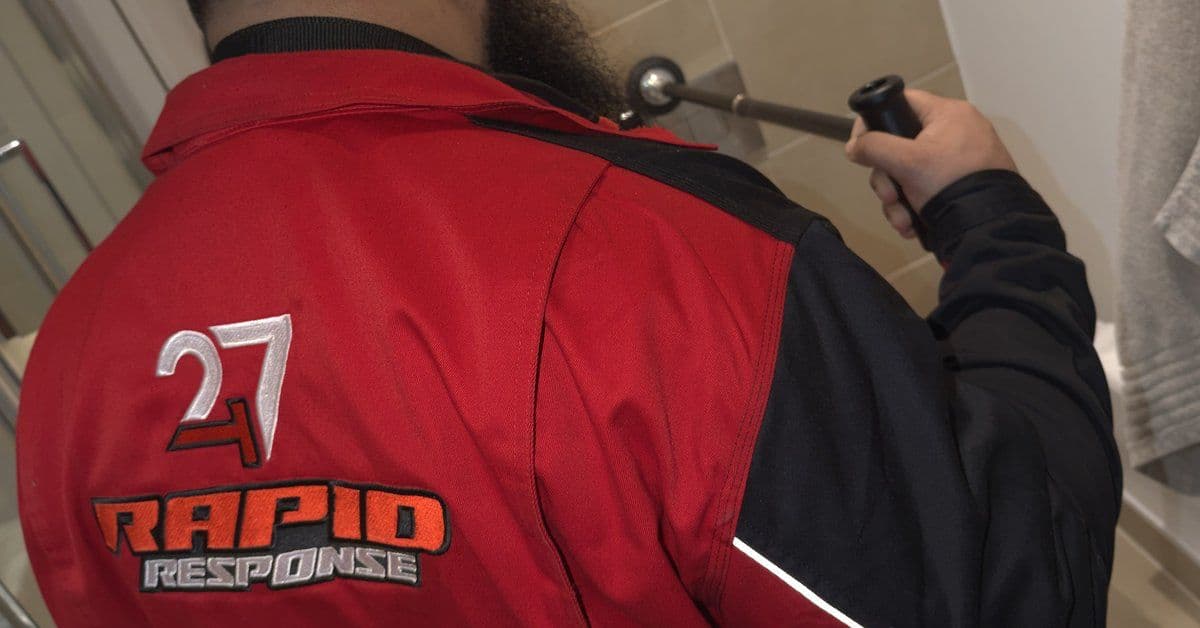
A reputable trades business invests in van sign-writing, branded uniforms, and engineer ID badges because its reputation is the asset. A van with no signage and a tradesman in unmarked clothing isn't always a scammer, but it's a flag worth scrutinising. Reputable operators have nothing to hide.
9. Undisclosed subcontracting via a faceless call centre
Some "emergency plumber" operators are call centres that take your booking and dispatch whichever freelance subcontractor is nearest. The customer thinks they're hiring "Brand X." Brand X has no quality control over the subcontractor who actually turns up. Ask directly: "Is the engineer attending today directly employed by your company on PAYE?" If the answer is no, you at least know what you're really hiring.
10. Demands full payment upfront before any work is done
A reasonable on-site diagnostics fee paid upfront (typically £40,£100) is normal industry practice, it covers the engineer's travel, time on site, and diagnostic work. But demanding the full job cost upfront before any work begins is a major red flag, especially on quotes over £500. Legitimate plumbers are happy to take a small deposit and the balance on completion. Deposits should never be paid in cash. Only by card to a registered company account.
11. No written 12-month workmanship guarantee
Quality trades stand behind their work. The industry standard in the UK is a 12-month workmanship guarantee, if the same fault returns within twelve months because of how it was installed or repaired, the company comes back and fixes it free of charge. If a plumber refuses to put this in writing, they don't stand behind their work.
12. Material markup of 50% or more on parts
Honest UK plumbers typically mark up materials by 25,35% over trade cost, that covers van stock, supplier accounts, returns and the cost of carrying inventory. Anything over 50% markup is unjustifiable and a sign of a company looking to over-charge. Always ask for the supplier reference and trade price. Reputable companies will share both. Our own published markup is 30% over trade cost, fully itemised on every invoice, see our pricing page.
13. The phone goes to voicemail in the evening or weekends
If a company markets itself as "24/7 emergency response" but its phone goes to voicemail at 8pm or on a Sunday, that's not 24/7, that's office hours with a misleading homepage. Test it by calling the company outside of business hours before you actually need them. Legitimate 24-hour operations have a real human picking up at 3am.
14. Hidden extras: parking, congestion, travel time, admin fees
Some operators advertise an attractive headline rate then load the invoice with hidden charges: parking, congestion charge, travel-time-each-way, admin fees, fuel surcharges, "out of area" surcharges. The legitimate model is an all-inclusive quote, the company absorbs operational costs as part of running a business. Always ask: "Is parking and congestion charge included in the quote?" Get the answer in writing.
15. Engineers without DBS / background checks
You're inviting a stranger into your home, possibly into your child's bedroom or near your elderly parent. Reputable companies run DBS (Disclosure and Barring Service) background checks on every engineer they employ. Smaller operators don't. Always ask "Do you DBS-check your engineers?", and if the answer is no, factor that into your decision.
16. Unqualified or unauthorised workers showing up on the day
A subset of operators advertise as "qualified plumbers" but actually dispatch general handymen or workers without legal right to work in the UK. Always ask the engineer at the door for: their photo ID card, their City & Guilds qualification number, their Gas Safe number (if it's gas work), and the company they're employed by. Reputable operators send the customer the engineer's name, photo and vehicle registration before arrival.
17. Charging you for material-collection time at full hourly rate
If the engineer has to leave site to collect a part, that's the cost of running their business, not a customer expense. Reasonable practice is one hour maximum of away-from-job time billed at most, and many companies (us included) absorb material-runs entirely under our 30%-markup model. Never accept being billed three hours for a part-run that should have been on the van.
18. Charging for two engineers when one would do
Some jobs genuinely need two pairs of hands, boiler installs, large bathroom rip-outs, bath/cylinder swaps. Most don't. If a company sends two engineers to a one-engineer job and bills you double, that's overcharging. Apprentices working alongside a qualified engineer should typically be at no charge to the customer (apprentices are an investment in the company's future workforce, not a billable resource), or at most an 80%-discounted rate.
19. No written invoice with itemised breakdown
A legitimate invoice shows: company name and Companies House number, VAT number, the engineer's name, date, full breakdown of labour by 30-minute increment, materials with supplier reference, parts receipts attached, total ex VAT, VAT separately, total inc VAT. If you receive a one-line invoice for "plumbing work, £950," that's not an invoice, that's a demand. Ask for the proper breakdown.
20. The "I'm just down the road" doorstep cold-caller
Cowboys often work doorstep-to-doorstep claiming "we're working on Mrs So-and-So's house at #42 and noticed your roof / pipework / boiler needs urgent attention." This is almost universally a scam. Never engage. Politely close the door. Always source your own tradesman through Gas Safe Register, your local council's Trading Standards approved list, Which? Trusted Traders, TrustMark, or a direct recommendation. Doorstep traders making unsolicited "you've got a problem" claims are regulated under the Consumer Protection from Unfair Trading Regulations 2008, they're not legal.
Five things you should never pay for
- A "one-hour minimum charge" just to take your booking. The diagnostics fee is paid when the engineer arrives, not when you ring up.
- Parking, congestion charge or travel time as separate line items. These are the company's operational costs.
- A "two-engineer" rate when only one engineer is doing the work. Apprentices should be free or at minimum 80% discounted.
- A cancellation fee on a job you cancel before the engineer is dispatched. Most operators allow free cancellation up to 30 to 60 minutes pre-arrival.
- An admin fee, dispatch fee or "booking fee" on top of the quote. The quote should be the quote.
The six free verification checks every London customer should do
You can verify any UK plumber for free in under 60 seconds before letting them work. Bookmark these:
- Gas Safe Register: gassaferegister.co.uk/find-an-engineer, search by company or registration number from the engineer's photo ID card. Confirms gas work is legal.
- : .org.uk/find-a-plumber, search by company name or postcode. Confirms compliance with the Water Supply (Water Fittings) Regulations 1999.
- Companies House: find-and-update.company-information.service.gov.uk, search the business name to confirm registration, registered office address, named directors, filing history, and active status. Free, official, takes 15 seconds.
- NICEIC / NAPIT (electrical work only): niceic.com/find-a-contractor or napit.org.uk/find-an-installer, confirms competence on Part P notifiable electrical work in dwellings.
- Google reviews: Check review volume, recency, ratio of 5-star to mid-tier ratings, and how the business responds to negative feedback. Five glowing reviews from 2019 = suspicious. 50+ reviews across three years with mixed feedback responded to professionally = genuine.
- Trading Standards / TrustMark / Which? Trusted Trader: Verified consumer-protection registers maintained by local councils and consumer bodies. UK-wide.
The questions every legitimate London plumbing company should be able to answer YES to
Print this list, take it to the door when an engineer arrives, ask each question. Walk away from anyone with three "no" answers:
- Is your engineer Gas Safe Registered (and can show me the card)?
- Is your engineer Gas Safe approved on plumbing work?
- Is your engineer City & Guilds qualified to Level 2 minimum?
- Is your engineer DBS checked and cleared?
- Does your engineer have legal right to work in the UK?
- Is your engineer directly employed by your company on PAYE, not a self-employed subcontractor?
- Is your engineer wearing branded company uniform with photo ID?
- Is the van that arrived sign-written with the company logo and registered with the company name?
- Did I receive the engineer's name, photo and vehicle registration before they arrived?
- Do you have £5M+ Public Liability and £10M Employer's Liability insurance, and can you email me the certificate?
- Is your company registered at Companies House with a verifiable address?
- Will I receive a written quote before any chargeable work begins?
- Do you provide a written 12-month workmanship guarantee?
- Will I receive an itemised invoice with labour, materials at trade cost, and parts receipts attached?
- Is parking, congestion charge and travel time included in the quote?
- Can I pay by credit card so I'm covered by Section 75 of the Consumer Credit Act?
- Are your phone lines genuinely answered by a human 24 hours a day, 7 days a week?
- Are your engineers' material markup transparent and capped, published on your website?
Spoiler: every one of those answers is yes for 247 Rapid Response. See our About page, pricing page, and Companies House registration to verify.
Twelve common London plumbing scams broken down
1. The "while I'm here..." up-sell
You called for a £100 toilet unblock. Mid-job, the engineer announces the soil pipe needs replacing for £2,400 "while we're here." Avoid by: always insisting on a written quote for unrelated work, getting a second opinion before authorising anything over £500, and never authorising major work on the same visit as a small reactive call.
2. The disappearing deposit
You pay 50% upfront for a bathroom install or boiler. Tradesman doesn't return. Phone disconnected. No trading address to chase. Avoid by: only paying deposits to verified Companies House businesses, only by card (so chargeback rights apply), never by cash, and never more than 25% upfront on jobs under £5,000.
3. The unsigned-off cowboy gas job
A non-Gas Safe operator fits your boiler. It works for six months. Then the heat exchanger fails because the engineer bypassed manufacturer commissioning. The manufacturer warranty is void (no Benchmark certificate). You pay for full replacement, often £3,000+. Avoid by: verifying Gas Safe registration BEFORE any gas work begins. Insisting on a Benchmark certificate on completion. Keeping the receipt for the boiler with the install date.
4. The "missing" trace-and-access insurance claim
You have a hidden water leak. Plumber rips up half the kitchen floor on a guess, charges £2,000+ for the destruction. Most home insurance policies include £5,10k of "trace and access" cover specifically to pay for proper leak detection (thermal imaging, acoustic, tracer gas). Cowboy operators don't know how to invoice it. Avoid by: choosing a plumber who uses non-destructive leak detection and provides insurance-grade reports, see our Insurance & Restoration service.
5. The "we'll register the boiler later" delay
Gas Safe requires every boiler installation to be registered (notified to Building Control) within 30 days. Cowboy operators "forget" to do this. Result: when you sell the property, the missing notification triggers a Homebuyer's Survey alert and reduces the property value by 5,10%. Avoid by: insisting on the Building Control compliance certificate within 30 days of install, in writing.
6. The "exposed" gas pipework reroute
You ask for a small bathroom modification. The engineer "discovers" the gas pipework is "non-compliant" and needs an urgent £1,500 reroute. Sometimes legitimate. Often invented. Avoid by: getting a second Gas Safe engineer's opinion before approving any gas pipework changes over £400.
7. The "blocked drain" up-charge
Simple sink unblock turns into "it's a main-line collapse, we need a £2,500 excavation." Without a CCTV survey to prove it, this is impossible to verify. Avoid by: insisting on a CCTV drain survey with the recording emailed to you, before authorising any drainage excavation work.
8. The fake-review smokescreen
A new operator with five 5-star reviews from accounts that have only ever reviewed that one company, all posted in the same week. Avoid by: checking review-account history (do they review other businesses?), checking review distribution (are some 4-star or 3-star with constructive feedback responded to?), checking publication dates (real review streams are continuous, not bursty).
9. The "we don't take card" excuse
"Our card machine is broken, can you pay cash today and we'll invoice you next week?" This costs you Section 75 protection on the spot. Avoid by: simply waiting for the card machine to "work", or asking for a bank transfer to the registered company account, which still leaves a paper trail.
10. The cancellation-fee racket
You book the job, change your mind 30 minutes later, get billed a £150 "cancellation fee." Most consumer law gives you a 14-day cooling-off period under the Consumer Contracts Regulations 2013 for distance / off-premises sales (which most online plumbing bookings are). Avoid by: reading the Ts & Cs before paying, and knowing your statutory cooling-off rights.
11. The "you have a leak underground" excavation grift
You report a damp patch in the garden. Within an hour someone has cut a £1,800 hole in your driveway claiming there's a leak in your supply pipe, when actually it was rainwater pooling. Avoid by: always insisting on a tracer-gas leak detection report or a thermal imaging survey BEFORE any excavation. Both are non-destructive and cost a fraction of a needless dig.
12. The "extract-the-maximum" overcharge culture
Some London plumbing operators run an internal culture of aggressive upselling and over-pricing, engineers pressured to maximise the bill on every job, materials marked up at 45,60%, vulnerable customers (elderly, ESL, time-pressured) targeted hardest. We name no specific company. The pattern is industry-wide and well-documented in trade-press exposés and consumer-protection complaints. Avoid by: always getting a second written quote on jobs over £500. Average quote variance in London is 20,30%; if one quote is double another for like-for-like work, you've found an overcharger.
What to do if you've been scammed by a London plumber
You have more rights than the cowboy will admit. Use them:
- Citizens Advice consumer helpline: 0808 223 1133 (free), first port of call
- Trading Standards: Citizens Advice will refer you to your local council's Trading Standards team, who pursue criminal cases against rogue traders
- Gas Safe Register Investigation Team: for any gas-related scam, they pursue criminal prosecutions of unregistered gas workers under the Gas Safety (Installation and Use) Regulations 1998
- Section 75 Consumer Credit Act 1974 chargeback: if you paid more than £100 and up to £30,000 by credit card, your card provider is jointly liable for breach of contract, you can claim a refund directly through them
- Card chargeback (under £100 or debit card): through your bank, within 120 days of transaction
- Action Fraud: 0300 123 2040 for outright fraud (UK national reporting)
- Small Claims Court: claims up to £10,000 (England & Wales), DIY-friendly process, court fee from £35
- Money Claim Online: the small claims gateway at gov.uk/make-money-claim
- Building Control complaints: for unregistered or non-compliant gas/heating installs, your local authority Building Control can issue compliance notices
Why we publish this guide
Putting a "how to spot rogue traders" guide on our own website might seem counter-intuitive, every customer who learns to verify properly is harder to win on a cold pitch. We're fine with that. The customers we want are the ones who do their homework: they verify Gas Safe, they read reviews, they check Companies House. Those customers stay loyal for decades because they recognise quality.
The "first cheap plumber on Google" customers churn through five companies a year and complain about every one. We'd rather have the informed ones. If this guide saves you from being scammed by someone else, great. If it convinces you to verify us first and then book us, also great. Either way, the London plumbing industry gets a little more honest with each customer who knows what to look for.
Verify 247 Rapid Response Ltd before you book us
Don't take our word for any of it. Run all six verification checks against us right now:
- Gas Safe Register: search "247 Rapid Response Ltd" at gassaferegister.co.uk
- : search "247 Rapid Response Ltd" at .org.uk
- Companies House: registration #14505329
- CHAS Elite, SafeContractor, Constructionline Gold, SMAS Worksafe: searchable on each scheme's website by company name
- Insurance: we'll email our Hiscox certificate (£5M Public Liability / £10M Employer's Liability) to any customer or managing agent on request
Frequently asked questions about rogue plumbers in London
How do I check if a London plumber is genuine?
Run the six free verification checks above: Gas Safe Register, Companies House, Google reviews, and Trading Standards / Which? Trusted Trader / TrustMark. A genuine plumber will pass all six. The whole process takes about 60 seconds.
What is the typical material markup of an honest London plumber?
Honest UK plumbers typically mark up materials 25,35% over trade cost, this covers van stock, supplier accounts, returns and inventory carrying costs. Anything over 50% markup is unjustifiable. 247 Rapid Response Ltd's published markup is 30% over trade cost, fully itemised on every invoice.
Can a London plumber legally charge me for parking and congestion charge?
Legally yes if it's disclosed in writing before the job. Reputable operators absorb these as the cost of running a London-based plumbing business. Always ask "Is parking and congestion charge included in the quote?" and get the answer in writing before authorising work.
What's the legal cooling-off period when I cancel a London plumbing booking?
Under the Consumer Contracts (Information, Cancellation and Additional Charges) Regulations 2013, you have a 14-day cooling-off period for most distance and off-premises sales, including online and over-the-phone bookings. Emergency callouts where you specifically request immediate work waive this right (s.36 of the regulations). Read the Ts & Cs before booking.
What's Section 75 protection and how does it help me with a rogue plumber?
Under Section 75 of the Consumer Credit Act 1974, if you pay between £100 and £30,000 for goods or services using a credit card (any portion of the payment counts), your credit card provider is jointly liable with the trader for breach of contract or misrepresentation. This means you can claim a refund directly from your credit card provider if the plumber fails to deliver what was promised. It's the single most powerful consumer protection in UK law, always pay by credit card on jobs over £100.
My boiler installer didn't register the install with Gas Safe. What now?
Every Gas Safe registered engineer must notify Gas Safe Register of any boiler install within 30 days of completion. This generates a Building Control compliance certificate which protects manufacturer warranty and your property's resale value. If your installer didn't register, contact Gas Safe Register Investigation Team, they will pursue the registration retrospectively or refer for prosecution if the installer is unregistered. For a remedial install registration, you may need to engage a fresh Gas Safe engineer to certify the existing install.
Should I let an apprentice work on my plumbing? Should I pay extra for them?
Yes to apprentices working alongside a qualified engineer, they're how the next generation of UK plumbers is trained, and a qualified engineer is supervising them. No to paying extra for them. Apprentices should be at no charge to the customer (the company invests in their training as a long-term workforce play) or at most a heavily discounted rate (industry norm: 80% discount). Apprentices should never work unsupervised on chargeable jobs.
What's the difference between a 24/7 plumber and a "24/7" plumber?
A genuine 24/7 emergency plumbing company has a real human picking up the phone at 3am on a Sunday. Many operators advertise "24/7" but route out-of-hours calls to voicemail, an answering service, or a single on-call freelancer. Test it before you need it: ring the company at 11pm one night and see what happens. 247 Rapid Response Ltd has live human dispatch every hour of every day across all 32 London boroughs.
If I'm scammed, can I get my money back?
Often yes, but it depends on how you paid. Credit card paid £100,£30,000: Section 75 chargeback through your card issuer. Debit card or under £100: chargeback under the card scheme rules within 120 days. Bank transfer: harder, but your bank may help under the Contingent Reimbursement Model for authorised push-payment fraud. Cash: almost impossible, this is why we say never pay cash. Plus the Small Claims Court is open to you for amounts up to £10,000 with a court fee from £35.
"The best customer is the educated customer. The best industry is the educated industry. We publish this guide because honest plumbing is everyone's business, including yours."
, MR 247, Founder & Director, 247 Rapid Response Ltd
Already been scammed by a London plumber?
Talk to us first.
Call the office before you pay any more, sign anything, or post publicly. We resolve over 90% of escalated complaints to the customer's satisfaction within seven days, even when the original work wasn't ours.
30 to 60 minute response across Greater London · Gas Safe registered #972173 · 12-month workmanship guarantee