Drainage
Soakaway failure repair across London
Specialist soakaway failure repair as part of our 24/7 drainage service. Same fixed pricing, same 30 to 60 minute target response, same 12-month guarantee.
A soakaway is a buried void that disperses surface water from your downpipes and patio drains into the surrounding subsoil. When it fails, the symptoms are obvious: standing water around the downpipe base after rainfall, gulleys that surcharge through the grating, waterlogged lawns above the soakaway footprint, and damp patches creeping up the lower courses of brickwork. In a wet London winter a failed soakaway can saturate the ground within metres of your foundations, and over time that hydrostatic loading is exactly what drives basement damp, cracked render, and movement of shallow Victorian footings. Soakaway failure rarely fixes itself, and percolation through compacted clay subsoils in north and east London is often the underlying reason the original design was never going to last.
We diagnose, dig out, and rebuild failed soakaways across all 33 London boroughs, working to BS 8000 part 14 for site practice and BRE Digest 365 for soakaway sizing and percolation testing. Most repairs we attend involve replacing legacy rubble-filled pits with modern geotextile-wrapped soakaway crates (typical capacity 200 to 600 litres per crate) sized against a fresh percolation test on the actual ground conditions. We coordinate the works around your downpipe runs, gulleys, and any rainwater harvesting tanks already on site, and where the local water table or clay content makes a soakaway uneconomic we will say so up front and price the alternative permitted connection instead.
Where this service applies
- Saturated ground around downpipe bases after every shower of rain
- Downpipe surcharge, water visibly rising back up the rainwater pipe
- Patio and driveway gulleys backfilling rather than draining
- Damp courses bridged by persistent waterlogging of the surrounding subsoil
- Failed rubble-filled or 1970s concrete-ring soakaways past end of life
- Properties on London clay where original percolation was marginal at best
- Loft conversions and rear extensions adding additional roof area to an existing soakaway
- Building Control sign-off requiring fresh BRE Digest 365 percolation evidence
- Insurance escape-of-water claims where soakaway failure has driven damp into the structure
How we deliver
No surprises, no upselling. The exact path every job follows.
-
1Site survey and downpipe trace
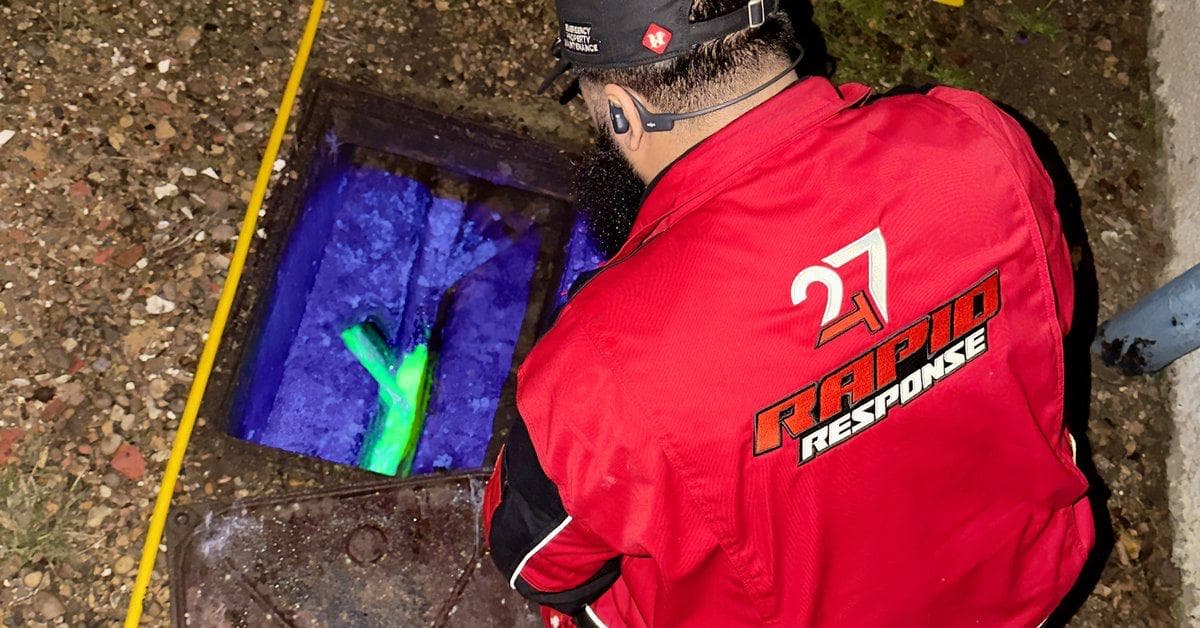
We map every downpipe feeding the suspected soakaway, dye-test the run, and confirm the failure is the soakaway and not a collapsed lateral or blocked gulley upstream. -
2BRE Digest 365 percolation test
Trial pit dug to design depth, soaked overnight, then timed three-pass drop test to derive the soil infiltration rate. Without this number any soakaway is guesswork. -
3Sizing calculation
Effective storage volume calculated against contributing roof area and the measured infiltration rate, all to BS 8000 part 14 with the 10-year return-period rainfall figures for your borough. -
4Excavation and removal
Failed pit fully excavated, legacy rubble or broken concrete rings carted off site, and the void inspected for groundwater ingress before backfill design is finalised. -
5Soakaway crate installation
Modular soakaway crates stacked to required volume, fully wrapped in non-woven geotextile membrane, inlet pipework dressed in at the correct invert and protected from silt loading. -
6Backfill, compaction, and reinstatement
Pea shingle surround, free-draining backfill to subgrade, and topsoil, slabs, or block paving reinstated to match the existing surface. -
7Commissioning flood test
Bowser-fed flood test through the downpipes, drawdown timed and recorded, photo and video evidence retained for Building Control or your insurer. -
8Written report and warranty
PDF report with percolation results, crate schedule, photographs, and a workmanship warranty you can hand to a conveyancer or loss adjuster.
Your questions answered
How much does soakaway repair cost in London?
How do I know my soakaway has actually failed?
Why does a soakaway need a percolation test?
Do I need Building Control approval to replace a soakaway?
What if the ground will not take a soakaway at all?
Need a 24/7 emergency engineer?
30 to 60 minute response across every London borough. Gas Safe registered. 12-month workmanship guarantee.
FAQ
Soakaway failure repair: your questions
How fast can you reach me for soakaway failure repair?
What does soakaway failure repair typically cost?
Is the work guaranteed?
Are you Gas Safe registered?
Read next
More on drainage
London’s Surge In Emergency Water-Damage: How To Control The First 24 Hours
Across London, demand for emergency water‑damage cleanup is rising. Industry reports attribute this growth to several converging factors: Ageing infrastructure: Many homes and commercial premises still rely on Victorian…
14 Mar 2026 · 8 min read
What London 24 7 Emergency Plumbing Should Deliver In Practice
Across major cities, round‑the‑clock plumbing has moved from a nice‑to‑have to an essential service. For London’s homes, offices, and rental properties, where outages and leaks can escalate quickly, the benchmark is…
15 Feb 2026 · 9 min read
24/7 Evidence-Led Emergency Property Repairs in London
When a pipe bursts behind a wall, a drain backs up, or a boiler fails in the middle of the night, every minute matters. Traditional “find-and-fix” methods often relied on exploratory dismantling, guesswork, and multiple…
13 Jan 2026 · 7 min read
London Sewer Maintenance Programmes: A Property Owner’s Guide to Preparation, Responsibilities, and Rapid Response
Across London, local authorities and water and sewerage companies routinely schedule high‑priority sewer evaluation and maintenance programmes. These programmes often run for several months in selected neighbourhoods,…
9 Jan 2026 · 9 min read
Need soakaway failure repair now?
30 to 60 minute response across every London borough. Gas Safe registered. 12-month workmanship guarantee.