
The soil stack is the vertical pipe that carries waste from every WC, basin, bath, and shower in your property down to the underground drain. When it leaks, the consequences are unpleasant: foul odours through the airing cupboard or boxing on a stairwell, brown staining bleeding through plasterboard, damp creeping across ceilings beneath upper-floor bathrooms, and on older cast iron stacks a slow but persistent corrosion of nearby joists and floorplates. London's pre-war housing stock still runs huge mileage of original cast iron soil pipe, much of it now well past its 80-year service life, and the typical failure points are the collar joints, the boss connections to WCs and basin wastes, and any horizontal offset where corrosion concentrates at the invert. Modern Floplast UPVC stacks fail differently, usually at solvent-weld joints disturbed during loft conversions or where push-fit seals have perished after two decades of expansion cycling.
We repair leaking soil stacks on both cast iron and UPVC systems, from a discreet internal collar repair through to a full external stack replacement in scaffold-safe sections. Our standard kit covers Geocel UPVC sealant for live UPVC joints, EPDM-lined stainless steel couplers for adapting cast iron to UPVC, and Floplast 110mm sections, branches, and access doors for full or partial renewals. We work to BS EN 12056-2 for sanitary drainage above ground, ensure venting and AAV provision is right (intermittent gurgling from a basin is almost always a venting problem, not a blockage), and where the leak has tracked into the structure we coordinate the drying and any insurance reinstatement under the same roof.
Where this service applies
- Foul odours from boxing, voids, or the airing cupboard
- Brown staining or damp on ceilings beneath an upstairs WC or bathroom
- Visible cracks or rust scaling on external cast iron stacks
- Leaking collar joints between cast iron sections
- Weeping boss connections at WC pan, basin, or bath wastes
- Failed solvent-weld joints on UPVC stacks after loft conversion works
- Gurgling traps, slow waste flow, or siphoning after a flush (venting failure)
- End-of-life replacement on Victorian and Edwardian cast iron stacks
- Insurance claims following a stack leak that has caused damage to ceilings, walls, or flooring
How we deliver
No surprises, no upselling. The exact path every job follows.
- 1
Stack inspection and material identification
Visual survey of the full vertical run, internal and external, identifying material (cast iron, UPVC, or hybrid), age, and any prior repairs or couplers. - 2
Leak location
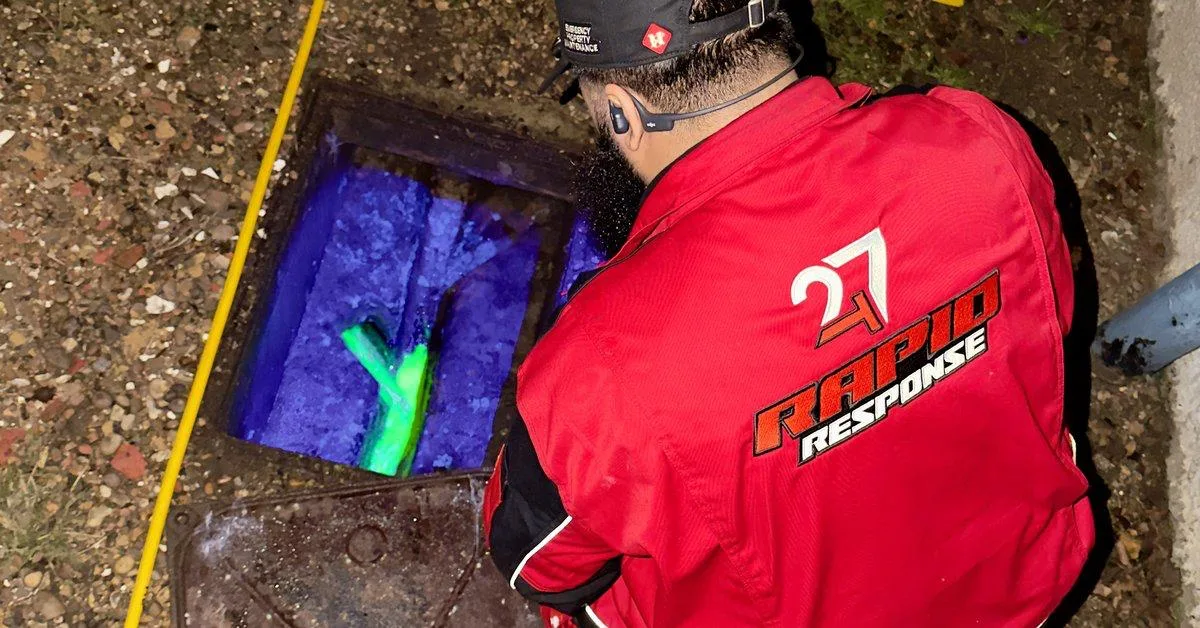
Smoke test or controlled water introduction at each upper-floor appliance to pinpoint the exact joint or section. Where the leak is concealed in plasterboard boxing we use thermal imaging before any cuts are made. - 3
Repair scope decision
Localised sealant, single section replacement, or full stack renewal, costed out against likely remaining service life. We tell you which option saves money long-term, not just today. - 4
Isolation and containment
Upper floors taken out of use during the repair window, dust sheeting and drip trays under the work area, and notices to neighbouring flats where the stack is shared. - 5
Repair or section replacement
Live joints sealed with Geocel UPVC sealant for short-term hold, or cut out and replaced with Floplast 110mm UPVC and EPDM-lined stainless couplers. Cast iron to UPVC transitions handled with proper adaptor sockets, never bodged with mastic. - 6
Venting and AAV check
Open-vent termination clear, or air-admittance valve serviceable and within the manufacturer's height tolerance. Many stack leaks coincide with venting failures and we will not leave one without the other resolved. - 7
Smoke and water test
Repaired stack pressure-tested by smoke and then flushed from each appliance in turn, with the repair zone observed for at least 15 minutes before sign-off. - 8
Photo report and warranty
Before and after photographs, materials schedule, and a workmanship warranty issued by PDF. Where the leak has caused damage we provide the insurance-grade report at no charge.