Leak detection
Ceiling leak and water-stain trace across London
Specialist ceiling leak and water-stain trace as part of our 24/7 leak detection service. Same fixed pricing, same 30 to 60 minute target response, same 12-month guarantee.
A brown ring on a bedroom ceiling, a soft sagging patch above the kitchen island, or a slow bulge in the lounge artex; ceiling stains are one of the most common reasons London leaseholders call us. The visible mark is rarely where the leak originates. Water tracks along joists, runs down service voids, and pools at the lowest plasterboard joint, which means the stain often sits 1 to 3 metres from the actual pinhole or failed seal feeding it. Find the wrong spot, and the cutting, drying, and redecoration costs balloon for no reason.
Our team uses a non-destructive workflow built around FLIR E76 and E96 thermal cameras, Protimeter Surveymaster dual-mode moisture meters, and acoustic loggers to triangulate the source from the cleanest possible side. Where the ceiling sits below a flat in a London leasehold block, we coordinate access with the upstairs occupier or managing agent, and we issue an insurance-grade written report with thermal images and moisture maps, so the trace-and-access cover on your policy pays for the diagnostic.
Where this service applies
- Brown or yellow ring stains on a ceiling below a bathroom, kitchen, or en-suite
- Bulging or sagging plasterboard where water is pooling above the skim
- Leasehold flats with a suspected leak from the property upstairs
- Active drip points around downlights, smoke alarms, or pendant fittings
- Slow staining linked to a recently used shower, bath, or washing machine
- Top-floor flats with possible roof, parapet, or Bauder felt flat-roof ingress
- Recurring stains that keep returning after redecoration
- Insurance trace-and-access claims for hidden escape-of-water sources
How we deliver
No surprises, no upselling. The exact path every job follows.
-
1Symptom interview and occupancy check
We log when the stain first appeared, what's directly above, and whether the upstairs flat or roof void has had recent works. For leasehold properties we confirm the access route with the managing agent before we leave the office. -
2Moisture mapping with Protimeter Surveymaster
We grid the affected ceiling in capacitance mode to a 200mm spacing, then pin-probe the worst readings to separate surface damp from a saturated substrate. -
3Thermal imaging sweep
A FLIR E76 or E96 sweep of the ceiling and the walls above reveals cooler evaporative plumes and warmer hot-feed leaks, typically pinpointing the source to within 100mm before we cut anything. -
4Upstairs verification
With the upstairs occupier's consent, we test each suspect fitting in turn: shower trap, bath waste, basin pop-up, WC pan connector, and washing-machine standpipe, watching the thermal signature change in real time. -
5Tracer-gas confirmation where needed
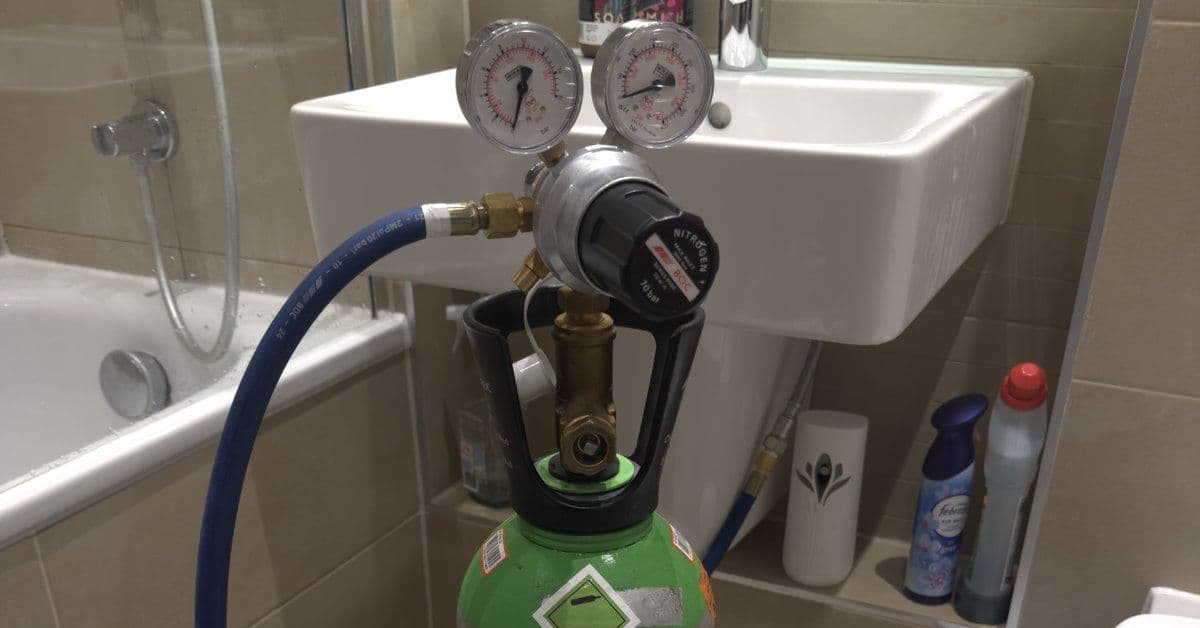
For pressurised pipework hidden in screed or behind tiles, we isolate the suspect circuit and introduce a 5% hydrogen, 95% nitrogen blend, then sniff the ceiling face to confirm the precise leak point. -
6Controlled access cut
Only after the source is confirmed do we make a tidy, minimum-size cut, usually a 300mm by 300mm square between joists, large enough for the repair, small enough for clean reinstatement. -
7Insurance-grade written report
Photos, moisture readings, thermal frames, and a marked-up floor plan, in the format required by Aviva, Direct Line, AXA, LV, and the major loss adjusters.
Your questions answered
How much does ceiling leak detection cost in London?
Will you have to cut a big hole in my ceiling?
The leak is coming from the flat above. Whose responsibility is it?
The ceiling is bulging. Is it about to come down?
Could the stain be from condensation rather than a leak?
Need a 24/7 emergency engineer?
30 to 60 minute response across every London borough. Gas Safe registered. 12-month workmanship guarantee.
FAQ
Ceiling leak and water-stain trace: your questions
How fast can you reach me for ceiling leak and water-stain trace?
What does ceiling leak and water-stain trace typically cost?
Is the work guaranteed?
Are you Gas Safe registered?
Read next
More on leak detection
London’s Surge In Emergency Water-Damage: How To Control The First 24 Hours
Across London, demand for emergency water‑damage cleanup is rising. Industry reports attribute this growth to several converging factors: Ageing infrastructure: Many homes and commercial premises still rely on Victorian…
14 Mar 2026 · 8 min read
Hidden Leaks, Minimal Damage: Non-Invasive Detection and Rapid Repair in London
Hidden water leaks are among the most costly and disruptive issues facing London homes and commercial premises. They push bills up, promote damp and mould, degrade indoor air quality, and silently weaken structures and…
6 Mar 2026 · 9 min read
What London 24 7 Emergency Plumbing Should Deliver In Practice
Across major cities, round‑the‑clock plumbing has moved from a nice‑to‑have to an essential service. For London’s homes, offices, and rental properties, where outages and leaks can escalate quickly, the benchmark is…
15 Feb 2026 · 9 min read
24/7 Evidence-Led Emergency Property Repairs in London
When a pipe bursts behind a wall, a drain backs up, or a boiler fails in the middle of the night, every minute matters. Traditional “find-and-fix” methods often relied on exploratory dismantling, guesswork, and multiple…
13 Jan 2026 · 7 min read
Need ceiling leak and water-stain trace now?
30 to 60 minute response across every London borough. Gas Safe registered. 12-month workmanship guarantee.