
Leak detection
Central heating leak detection across London
Specialist central heating leak detection as part of our 24/7 leak detection service. Same fixed pricing, same 30 to 60 minute target response, same 12-month guarantee.
Central heating leak detection in London finds the pinhole on a sealed system that keeps losing pressure, without breaking through every wall and floor to look.
Pressure loss on a sealed system is the symptom we are asked about most often, the boiler drops from 1.2 bar to 0.8 bar over a few days, the customer tops it up at the filling loop, and within a week the gauge has dropped again. Unlike a mains-fed plumbing leak the system is closed, inhibitor-dosed (Sentinel X100 or Fernox F1) and circulates only between the boiler, the pump, and the radiators. A small loss can hide for months without showing as a wet patch, because the leak rate is too low to soak through a ceiling but fast enough to push the system below the low-pressure cut-out. This survey finds where it is going before you redecorate over the wrong wall.
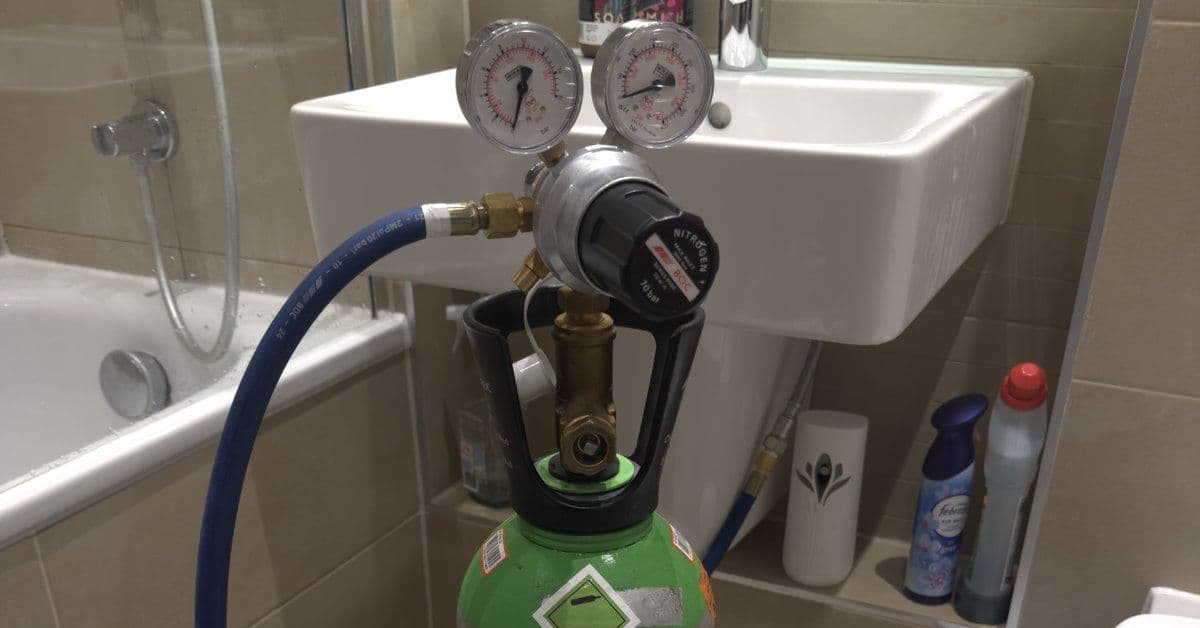
We charge to working pressure with a mains-fed filling loop, then isolate the boiler from the loop at the flow and return service valves so the radiator circuit can be pressure-drop tested separately from the boiler internals (heat-exchanger pinhole, diverter-valve cartridge seal, expansion-vessel diaphragm rupture). Once the loss is narrowed to either side we move zone by zone, isolating ground floor from first floor and microbore runs from 22mm trunk runs until the leak rate localises. Thermal imaging with a FLIR camera on hot pipework finds cold trails of leaks under floors, and tracer gas (the standard 5 per cent hydrogen and 95 per cent nitrogen mix) introduced into the depressurised circuit and read at the surface with a Sewerin Variotec pins the pinhole to within centimetres. Common London-stock sources: corrosion pinholes on radiator return tappings (the cold-leg oxygen side), perished pump-head seals on older Grundfos UPS units, towel-rail valve tail glands, and pinholes on 8mm microbore under suspended timber floors. After any top-up we redose inhibitor to BS 7593.
Where this service applies
- Boiler pressure dropping from 1.2 bar to under 1.0 bar within days of topping up
- Filling loop being used weekly or more often to keep the system in range
- Damp patch under a radiator, on a towel-rail valve tail, or beneath a heating-run board
- Recurring low-pressure boiler lockouts after the system has run hot
- Microbore under suspended timber floors in Victorian and 1930s London terraces
- Heating-side leaks behind plastered walls with no visible trail
- Pre-power-flush check to rule out a leak before chemicals are introduced
- Insurance trace-and-access on a heating leak with insurer-grade report
How we deliver
No surprises, no upselling. The exact path every job follows.
-
1System recharge to working pressure
Filling loop opened, system brought to 1.2 bar cold. Gauge sealed and watched. -
2Boiler isolation and split test
Flow and return service valves closed so the loop and the boiler internals are pressure-tested separately. Drop rate measured on each side over 30 minutes. -
3Boiler internal check
If the boiler side drops we check the expansion-vessel pre-charge, diverter-valve cartridge seal, heat exchanger for pinholes, and pump-head gasket. -
4Zone isolation on the loop
Loop-side drop, we isolate ground floor from first floor, microbore from trunk, towel-rail circuits from radiator circuits, until the leak localises to a specific zone. -
5Thermal imaging sweep
FLIR camera over the suspect zone with the system hot, looking for cold trails on floor and wall finishes where heated water has been escaping. -
6Tracer gas localisation
5 per cent hydrogen and 95 per cent nitrogen mix introduced into the depressurised zone, surface scan with a Sewerin Variotec to pin the leak point to within centimetres. -
7Repair quote and inhibitor redose
Written report with leak location, photographs, and a separate repair quote. After any top-up we redose Sentinel X100 or Fernox F1 to BS 7593.
Your questions answered
Why does my combi boiler keep losing pressure?
How much does central heating leak detection cost in London?
How long does heating leak detection take?
Will you find a heating leak without damaging my floors?
Do I need to redose the inhibitor after a heating leak?
Need a 24/7 emergency engineer?
30 to 60 minute response across every London borough. Gas Safe registered. 12-month workmanship guarantee.
FAQ
Central heating leak detection: your questions
How fast can you reach me for central heating leak detection?
What does central heating leak detection typically cost?
Is the work guaranteed?
Are you Gas Safe registered?
Read next
More on leak detection
London’s Surge In Emergency Water-Damage: How To Control The First 24 Hours
Across London, demand for emergency water‑damage cleanup is rising. Industry reports attribute this growth to several converging factors: Ageing infrastructure: Many homes and commercial premises still rely on Victorian…
14 Mar 2026 · 8 min read
Hidden Leaks, Minimal Damage: Non-Invasive Detection and Rapid Repair in London
Hidden water leaks are among the most costly and disruptive issues facing London homes and commercial premises. They push bills up, promote damp and mould, degrade indoor air quality, and silently weaken structures and…
6 Mar 2026 · 9 min read
What London 24 7 Emergency Plumbing Should Deliver In Practice
Across major cities, round‑the‑clock plumbing has moved from a nice‑to‑have to an essential service. For London’s homes, offices, and rental properties, where outages and leaks can escalate quickly, the benchmark is…
15 Feb 2026 · 9 min read
24/7 Evidence-Led Emergency Property Repairs in London
When a pipe bursts behind a wall, a drain backs up, or a boiler fails in the middle of the night, every minute matters. Traditional “find-and-fix” methods often relied on exploratory dismantling, guesswork, and multiple…
13 Jan 2026 · 7 min read
Need central heating leak detection now?
30 to 60 minute response across every London borough. Gas Safe registered. 12-month workmanship guarantee.