
Leak detection
Concrete slab leak detection across London
Specialist concrete slab leak detection as part of our 24/7 leak detection service. Same fixed pricing, same 30 to 60 minute target response, same 12-month guarantee.
Concrete slab leak detection finds the pipe leak buried under a poured floor slab, common in 1960s and later London blocks, basement conversions, and underfloor heating retrofits, without breaking the whole floor up.
A slab leak is different from a leak under timber joists. The pipework is encased in the slab itself or laid on the sub-base and screed-buried, with no void to listen in and no joist to lift a board off. London stock from the 1960s, 1970s, and 1980s, council and developer estates and lower-ground floors converted into basement living space, often runs the entire cold supply, hot return, and central heating microbore through the slab. Wet underfloor heating retrofits add another large set of buried pipework. When one of those runs pinholes the water surfaces unpredictably: a damp tile grout line metres from the pinhole, a warm patch on a cold floor, a drop in mains pressure, or a heating-system pressure loss that survives an above-floor pressure test.
We start with the standard baseline, a meter test to confirm a mains-side leak and a sealed pressure-drop test on the heating loop to confirm which line is the target. Acoustic listening uses a Sewerin AquaPhon ground microphone with a hard-floor adaptor to pick up the leak hiss conducted through the concrete. Thermal imaging is the second method, effective on hot-water and heating-side leaks because the slab surface develops a warm spot directly above the leak. Where acoustic does not carry through dense aggregate or reinforced slabs, we depressurise the line and charge it with the standard 5 per cent hydrogen and 95 per cent nitrogen tracer-gas mix, read at the surface with a Sewerin Variotec. Once the leak is pinned to within 100 to 200mm the customer has two repair options: a surface-laid bypass with decorative cover (cheaper, visible), or a roughly 300mm by 300mm access pad cut in the slab, repair in copper or MLCP, concrete recap, and floor finish reinstated to match. The pad option is the most common.
Where this service applies
- 1960s to 1980s London flats and houses with screeded concrete ground floors
- Basement and lower-ground conversions with buried cold supply and heating loops
- Wet underfloor heating retrofits with screed-buried PEX or PERT loops
- Warm patch on a tiled or stone floor where the heating is not zoned
- Damp tile-grout pattern surfacing away from the nearest visible fixture
- Mains meter spinning with every tap closed and no leak above the floor
- Heating-loop pressure loss surviving an above-floor pressure-drop test
- Insurance trace-and-access on a slab leak requiring an insurer-grade report
How we deliver
No surprises, no upselling. The exact path every job follows.
-
1Meter and sealed pressure test
Mains meter test for a cold-side leak, sealed pressure-drop test on the heating circuit for a hot-side leak. Establishes which line is the target. -
2Acoustic listening through the slab
Sewerin AquaPhon ground microphone with hard-floor adaptor walked over the suspect zone, picking up the leak hiss conducted through the concrete. -
3Thermal imaging sweep
FLIR thermal camera across the slab surface with the heating on. A warm spot where the surface should be ambient is a strong indicator of a hot-water or underfloor-heating leak directly underneath. -
4Tracer gas where acoustic fails
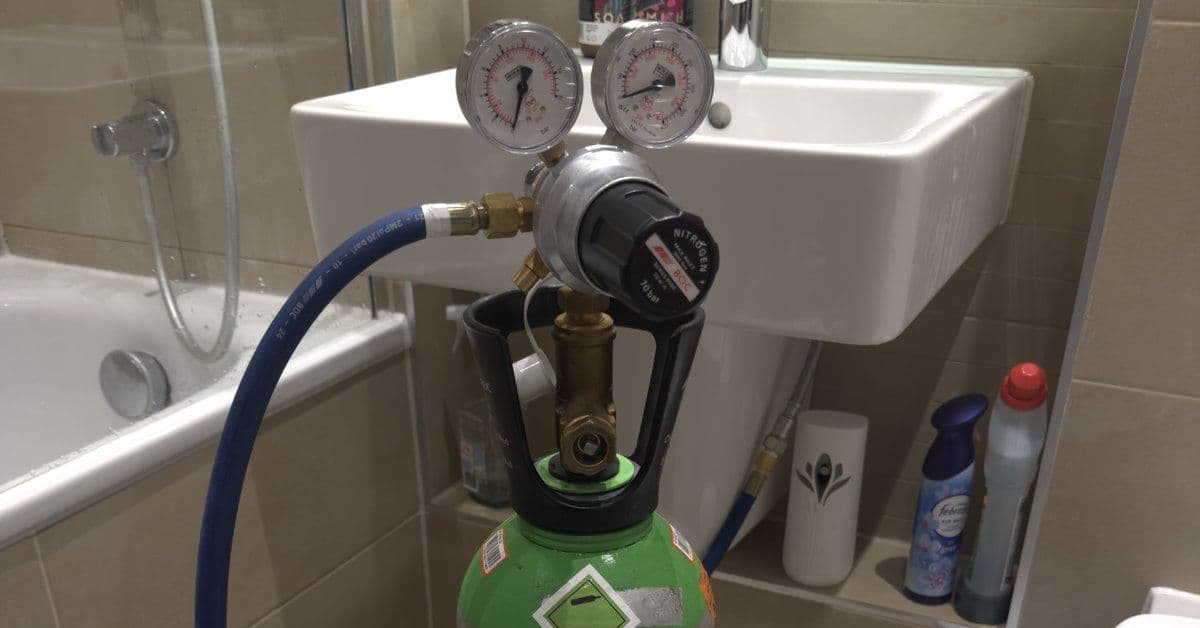
On dense aggregate or reinforced floors, the line is depressurised and charged with 5 per cent H2 and 95 per cent N2, read at the surface with a Sewerin Variotec. Pins the leak to within 100 to 200mm. -
5Repair-option appraisal
Customer is shown two costed options, a surface-laid bypass with decorative cover, or a 300mm by 300mm slab access pad with concrete recap and matching floor finish. Most pick the access pad. -
6Controlled slab cut
300mm by 300mm cut with a wet diamond cutter to contain dust, leak exposed, repaired in copper or MLCP with mechanical or press-fit joints, and pressure-tested. -
7Reinstatement and report
Pad recapped with structural concrete to slab level, floor finish matched (tile, screed, vinyl, engineered timber), written report with photographs and a separate repair invoice for insurers.
Your questions answered
How much does concrete slab leak detection cost in London?
How long does the survey take?
Why does a slab leak cost more than a leak under floorboards?
Will my underfloor heating still work after the repair?
Will my insurance cover slab leak detection?
Need a 24/7 emergency engineer?
30 to 60 minute response across every London borough. Gas Safe registered. 12-month workmanship guarantee.
FAQ
Concrete slab leak detection: your questions
How fast can you reach me for concrete slab leak detection?
What does concrete slab leak detection typically cost?
Is the work guaranteed?
Are you Gas Safe registered?
Read next
More on leak detection
London’s Surge In Emergency Water-Damage: How To Control The First 24 Hours
Across London, demand for emergency water‑damage cleanup is rising. Industry reports attribute this growth to several converging factors: Ageing infrastructure: Many homes and commercial premises still rely on Victorian…
14 Mar 2026 · 8 min read
Hidden Leaks, Minimal Damage: Non-Invasive Detection and Rapid Repair in London
Hidden water leaks are among the most costly and disruptive issues facing London homes and commercial premises. They push bills up, promote damp and mould, degrade indoor air quality, and silently weaken structures and…
6 Mar 2026 · 9 min read
What London 24 7 Emergency Plumbing Should Deliver In Practice
Across major cities, round‑the‑clock plumbing has moved from a nice‑to‑have to an essential service. For London’s homes, offices, and rental properties, where outages and leaks can escalate quickly, the benchmark is…
15 Feb 2026 · 9 min read
24/7 Evidence-Led Emergency Property Repairs in London
When a pipe bursts behind a wall, a drain backs up, or a boiler fails in the middle of the night, every minute matters. Traditional “find-and-fix” methods often relied on exploratory dismantling, guesswork, and multiple…
13 Jan 2026 · 7 min read
Need concrete slab leak detection now?
30 to 60 minute response across every London borough. Gas Safe registered. 12-month workmanship guarantee.