

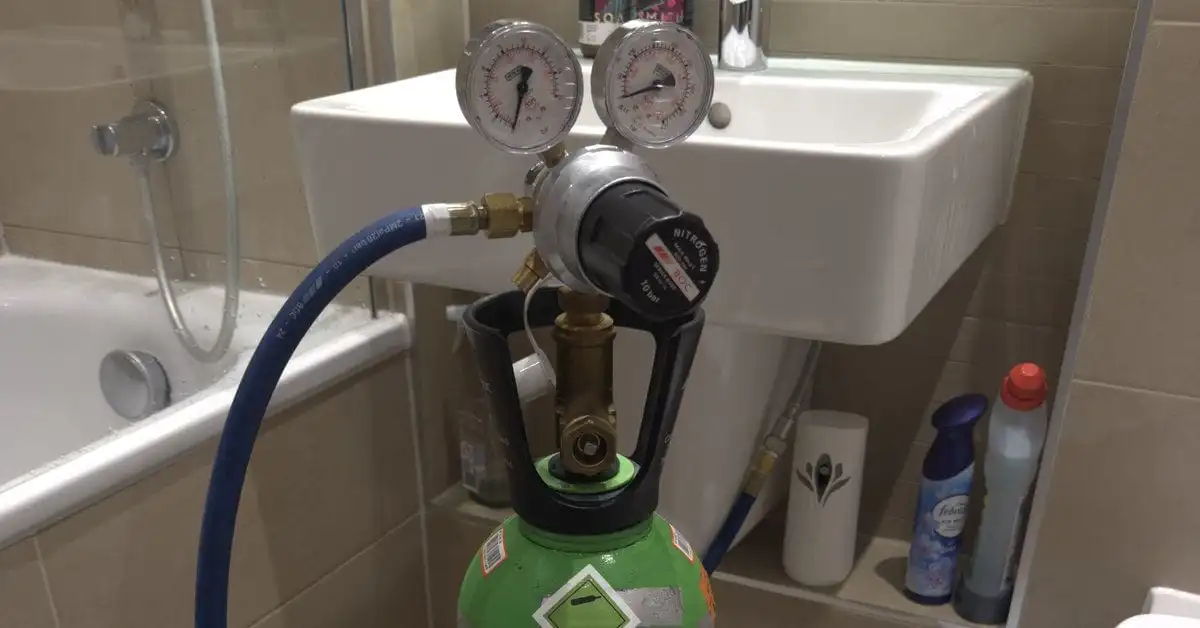
When thermal imaging and acoustic detection have ruled out the obvious but the leak still hasn't shown itself, tracer gas is the technique that closes the case. The principle is simple: hydrogen molecules are roughly half the size of water molecules, so they escape through any leak point that water can pass, usually faster and more reliably than the water itself. Detection probes calibrated to parts-per-million sensitivity reveal the gas as it emerges, even through 50mm of screed, floor finishes, plaster or insulation.
We use a 5% hydrogen / 95% nitrogen industrial tracer mix, the same standard used by Cadent Gas, Thames Water and other UK utility infrastructure operators. The mix is non-toxic, non-flammable (well below the lower explosive limit of 4%), inert to building materials, and harmless to human and animal occupancy. It's the safest and most precise leak-locating method available.
Where this service applies
- Underground supply pipes (MDPE, lead) where excavation cost makes precise location critical
- Sub-floor pipework under solid screed floors
- Pipework buried in walls or behind cladding
- Cases where thermal imaging hasn't been conclusive
- Cases where acoustic detection isn't possible (plastic pipework)
- Underfloor heating system leaks
- Swimming pool / hot tub plumbing leaks
- Insurance claims requiring leak source verification
How we deliver
No surprises, no upselling. The exact path every job follows.
- 1
System depressurisation & drain-down
All water removed from the suspect system. - 2
Tracer gas introduction
5/95 H₂/N₂ mix introduced at low controlled pressure (typically 0.2 bar). - 3
Surface scan with sniffer probe
Sensitive electronic detector run across all suspect surfaces. - 4
Pinpoint isolation
Where improved readings detected, micro-survey to identify exact leak point. - 5
Verification scan
Repeat scan to confirm location is repeatable and not a false positive. - 6
System recommissioning
Gas vented. System re-pressurised with water. Final integrity test. - 7
Insurance-grade written report
Located leak point marked on plan. Recommended access cut.