Showers fail in three predictable ways: they drip when shut off, they lose pressure or flow, or they swing between scalding and freezing as the cartridge or solenoid loses temperature control. The cause depends on the type. Thermostatic mixer cartridges on Aqualisa, Mira, and Bristan units scale up in hard-water postcodes and lose their wax-element response. Manual mixer cartridges wear at the ceramic disc and start to bypass. Electric showers fail at the heater tank element, the microswitch, the flow valve, or the solenoid in that rough order. And no-flow complaints are very often nothing to do with the shower itself, they are an isolation valve closed, a stored-water cylinder run cold, or a 22mm cold supply choked by limescale on the gravity feed from a loft tank.
We diagnose first, parts second. Every shower visit starts with a pressure and temperature check at the inlets, a flow-rate measurement at the head, and a visual on the cartridge, the diverter, and the head itself. Where a thermostatic cartridge has failed we fit a genuine Aqualisa, Mira, or Bristan replacement so the calibration matches the original body. Electric showers are tested with insulation and continuity readings on the element and solenoid before parts are ordered. Where the shower itself is beyond economic repair we recommend a like-for-like or upgraded mixer shower and quote on a fixed basis before any work starts.
Where this service applies
- Dripping shower head or diverter after the lever has been turned off
- Thermostatic mixer cycling between hot and cold, calibration drift on Aqualisa, Mira, or Bristan cartridges
- No flow at the head despite full hot and cold supply at adjacent taps
- Weak flow only on the shower while basin taps run normally, typical of a choked rose or limescaled cartridge
- Electric shower trips the RCD or runs cold, element or solenoid failure on Mira Sport, Triton, or similar
- Pull-cord switch failure on a ceiling-mounted electric shower isolator
- Leaking shower hose, head, or wall outlet causing damp on the tile face or below
- Gravity-fed shower losing pressure as the cold cistern empties faster than it refills
- Booster pump fault on a power-showered installation, separate quote on our pump replacement page
How we deliver
No surprises, no upselling. The exact path every job follows.
- 1
Symptom triage
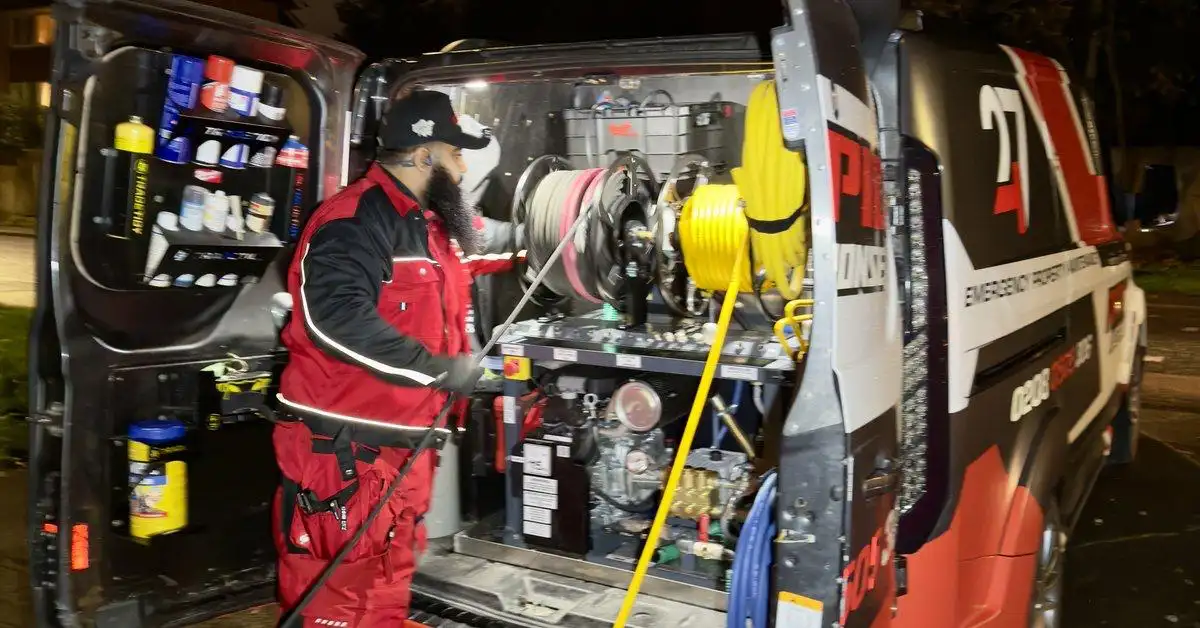
We identify the shower type (thermostatic mixer, manual mixer, electric, or power shower) and the failure mode (drip, no flow, no temperature, intermittent) so the right diagnostic kit comes off the van. - 2
Pressure and flow check at the inlets
Hot and cold inlets isolated and gauged, flow measured at the head, and the head and hose checked for scale. This often resolves no-pressure complaints without opening the valve body at all. - 3
Cartridge or component test
On mixer showers the cartridge is stripped, inspected for scale and disc wear, and either descaled or replaced. On electric showers the element, solenoid, and microswitch are tested with a multimeter before any part is ordered. - 4
Repair-or-replace recommendation
If a genuine cartridge is available and economic, we fit it. If the body is corroded, the chrome failing, or the model long discontinued, we quote a like-for-like replacement before any further work. - 5
Part fitted and resealed
Genuine Aqualisa, Mira, or Bristan thermostatic cartridge fitted with new O-rings, or new shower body installed in the existing wall holes with a fresh silicone weather-seal on the wall plate. - 6
Calibration and temperature check
Thermostatic units calibrated to 38C set-point with a digital thermometer at the head. The 43C upper limit-stop is verified, and the unit is cycled hot-to-cold to confirm response. - 7
Site cleared and tested in service
Old parts bagged, area wiped down, and the shower run through three full cycles to confirm stable flow and temperature before we leave.